
Introduction: The Myanmar Opportunity Paradox and the Hidden Cost Problem
Myanmar presents one of the most compelling yet challenging expansion opportunities in Southeast Asia today. As a strategic gateway between China and India, this emerging market offers access to a young, cost-competitive workforce of 54 million people, abundant natural resources, and significant untapped potential across manufacturing, technology, and service sectors.
However, beneath the surface of attractive labor costs and growth prospects lies a complex reality that has caught many international businesses off guard. The political instability following the February 2021 military coup has fundamentally altered the risk landscape, creating an environment where traditional business expansion strategies require complete recalibration.
For companies considering Myanmar market entry, Employer of Record (EOR) services have emerged as the preferred expansion strategy. EOR providers handle employment compliance, payroll processing, and legal responsibilities while allowing businesses to hire local talent without establishing a legal entity. This approach offers speed, flexibility, and significantly reduced regulatory exposure—critical advantages in Myanmar's current environment.
Yet here lies a critical trap that costs businesses thousands of dollars annually: the overwhelming majority of companies make EOR decisions based purely on advertised monthly fees, typically ranging from $199 to $699 per employee. These surface-level prices represent only the tip of the iceberg in terms of actual costs.
This comprehensive guide introduces a Total Cost of Ownership (TCO) framework specifically designed for Myanmar EOR evaluation. Unlike simple price comparisons, TCO analysis reveals the complete financial picture, including hidden compliance costs, political risk premiums, industry-specific expenses, and infrastructure challenges that can easily double or triple your expected investment.
We'll also present a Risk-Adjusted ROI methodology that factors Myanmar's unique political uncertainties into your investment calculations, providing the analytical foundation for confident decision-making in this complex market.
Whether you're a startup testing market viability or an established enterprise planning substantial Myanmar operations, this framework will equip you with the tools to navigate beyond surface-level marketing claims and identify the EOR partnership that delivers genuine value for your specific situation.
Why Total Cost of Ownership Analysis is Critical for Myanmar EOR Success
The $199-$699 Monthly Fee Illusion
When researching Myanmar EOR services, you'll encounter an attractive array of monthly pricing plans starting from just $199 per employee. These figures seem remarkably reasonable compared to the costs and complexity of establishing a local subsidiary, which can require $50,000+ in initial investment and 3-6 months of setup time.
However, these advertised rates typically cover only basic employment administration: contract creation, payroll processing, and tax filing. What they don't include are the Myanmar-specific complexities that can dramatically impact your actual costs:
Mandatory Social Security Contributions: Myanmar law requires employers to contribute 3% of each employee's salary to the Social Security Fund, with employees contributing an additional 2%. While this may seem straightforward, the compliance management, documentation requirements, and monthly reporting obligations add administrative overhead that's rarely included in base pricing.
Political Risk Compliance Costs: Since 2021, Myanmar's regulatory environment has become increasingly unpredictable. EOR providers must now invest significantly more in legal monitoring, compliance updates, and contingency planning. These costs are often passed through to clients as additional fees or absorbed into higher service charges.
Infrastructure Supplementation Needs: Myanmar's power grid remains unreliable, with frequent outages affecting business operations. Internet connectivity can be unstable, and banking systems face ongoing challenges. Many businesses discover they need additional services—backup power solutions, alternative communication channels, or enhanced financial management—that aren't covered in standard EOR packages.
The Four Hidden Cost Categories in Myanmar EOR
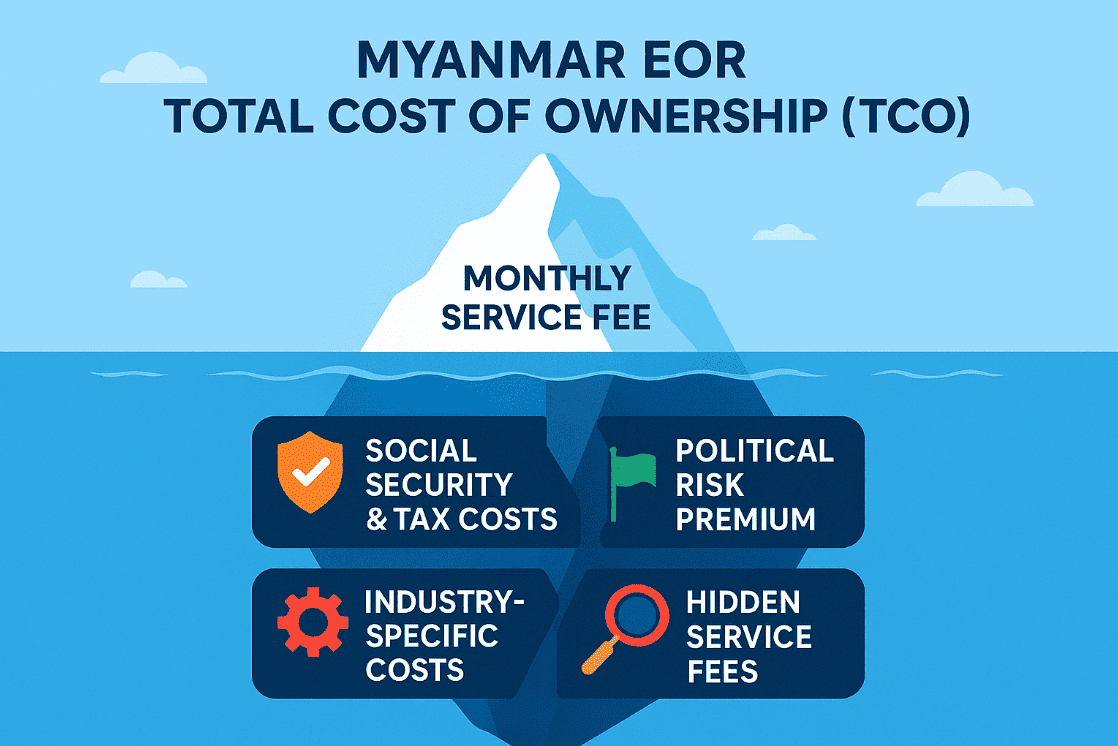
A comprehensive TCO analysis for Myanmar EOR must account for four critical cost categories beyond the base monthly fee:
1. Compliance and Legal Risk Management
Myanmar's employment laws are complex and frequently updated, particularly regarding foreign worker regulations and social security requirements. Professional EOR providers maintain teams of local legal experts to navigate these complexities, but this expertise comes at a premium.
Hidden costs include:
- Enhanced compliance monitoring and reporting
- Legal consultation for contract modifications
- Regulatory change management and communication
- Emergency legal support during policy shifts
2. Political Risk Premium
Myanmar's current political environment introduces risks that simply don't exist in more stable markets. Quality EOR providers invest in risk mitigation strategies, business continuity planning, and emergency response capabilities.
These investments translate to:
- Enhanced security protocols and monitoring
- Diversified operational capabilities
- Emergency evacuation or business closure support
- Political risk insurance and contingency funds
3. Industry-Specific Operational Costs
Different sectors face unique challenges in Myanmar that impact EOR service requirements:
Manufacturing Companies need:
- Specialized safety and compliance support
- Enhanced logistics coordination during infrastructure disruptions
- Backup operational support for power outages
- Supply chain risk management
Technology Companies require:
- Higher-caliber talent recruitment (often 2-3x base salary costs)
- Enhanced data security and communications infrastructure
- Specialized intellectual property protection
- Advanced technical compliance for software development
4. Service Enhancement and Support Costs
Myanmar's challenging business environment often necessitates services that would be optional in more developed markets:
- 24/7 emergency support capabilities
- Enhanced financial management during currency fluctuations
- Expedited visa and work permit processing
- Local relationship management and government liaison
Understanding these four categories is essential for accurate cost forecasting and EOR provider comparison. Companies that fail to account for these hidden costs often find themselves facing budget overruns of 40-60% within their first year of operations.
Complete TCO Calculation Framework for Myanmar EOR
Step 1: Comprehensive Cost Assessment Template
Use this framework to calculate the true cost of Myanmar EOR services. Each component should be evaluated for every EOR provider you're considering:
| Cost Category | Description | Calculation Method | Monthly Cost per Employee |
|---|---|---|---|
| Base Service Fee | Advertised monthly EOR rate for standard employment services | Provider quote | $_______ |
| Social Security & Tax Admin | Employer contributions (3% of salary) plus administrative overhead | (Salary × 0.03) + $50 admin fee | $_______ |
| Political Risk Premium | Enhanced compliance, monitoring, and contingency planning costs | Base fee × 15-30% risk factor | $_______ |
| Industry-Specific Costs | Sector-related compliance, recruitment, or operational requirements | Varies by industry (see below) | $_______ |
| Infrastructure Support | Backup systems, enhanced communications, emergency protocols | $100-300 per employee | $_______ |
| Service Enhancements | Optional but often necessary services in Myanmar environment | As quoted by provider | $_______ |
| TOTAL MONTHLY TCO | Complete cost per employee | Sum of all categories | $_______ |
Step 2: Industry-Specific Cost Adjustments
Apply these sector-specific adjustments to your TCO calculation:
Manufacturing & Production:
- Add 20-35% for enhanced safety compliance and operational support
- Include $200-500 per employee for infrastructure backup requirements
- Factor in potential productivity losses during power outages (5-10% salary cost)
Technology & Software Development:
- Premium talent costs: 150-300% of standard salary ranges
- Enhanced security and IP protection: $150-250 per employee monthly
- Advanced technical compliance: $100-200 per employee monthly
Service & Consulting Industries:
- Enhanced communication infrastructure: $75-150 per employee monthly
- Client management during political disruptions: $50-100 per employee monthly
- Professional liability and compliance support: $100-175 per employee monthly
Step 3: Risk-Adjusted ROI Calculation
Traditional ROI calculations don't account for political and operational risks. Use this enhanced methodology:
Standard ROI Formula:
ROI = (Expected Revenue - Total Costs) / Total Costs × 100
Risk-Adjusted ROI Formula:
Adjusted ROI = (Expected Revenue - TCO) / TCO × (1 - Political Risk Factor) × 100
Political Risk Factors for Myanmar (2025):
- Conservative Approach: 35% risk factor (0.35)
- Moderate Approach: 25% risk factor (0.25)
- Aggressive Approach: 15% risk factor (0.15)
Example Calculation:
- Expected Annual Revenue: $180,000
- Annual TCO: $120,000
- Political Risk Factor: 25% (moderate)
Standard ROI: ($180,000 - $120,000) / $120,000 × 100 = 50%
Risk-Adjusted ROI: 50% × (1 - 0.25) = 37.5%
This 12.5 percentage point difference represents the "political risk discount" you should apply to Myanmar investments. While still attractive, the risk-adjusted figure provides a more realistic expectation for decision-making.
Step 4: Break-Even Analysis
Calculate how long your Myanmar operations need to run to justify the TCO investment:
Break-Even Timeline = Total TCO Investment / (Monthly Revenue - Monthly Operating Costs)
This analysis helps determine whether Myanmar EOR makes financial sense for your specific business model and timeline expectations.
Company Size-Specific Myanmar EOR Strategies
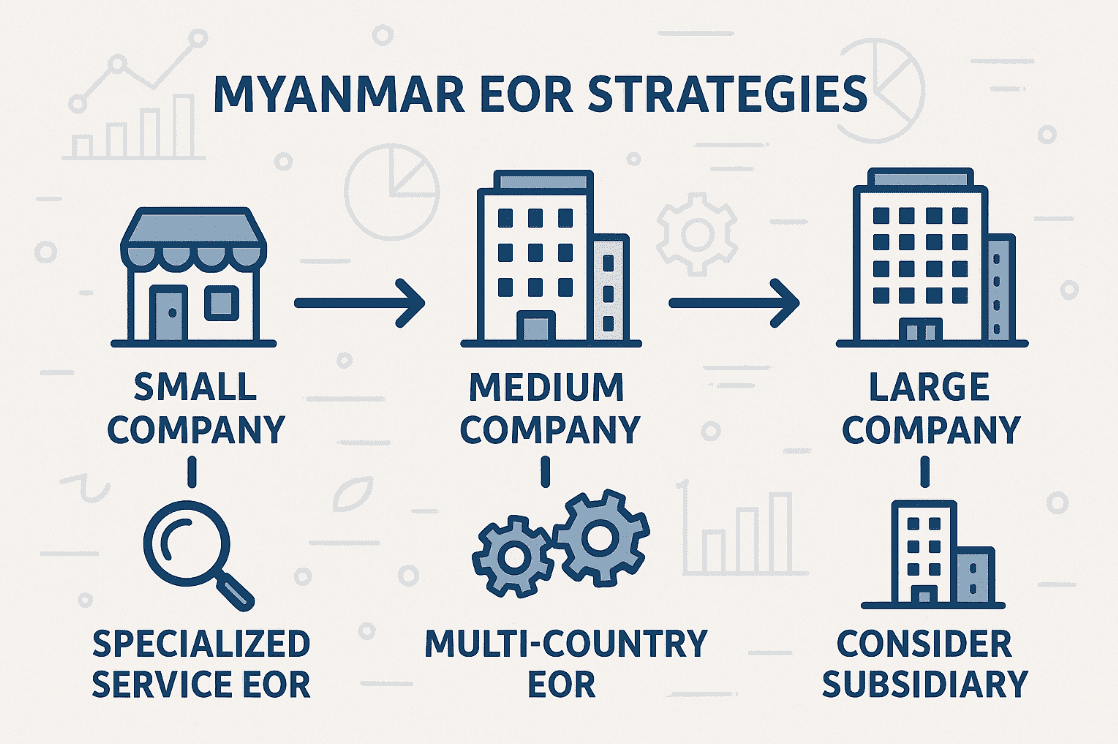
Startups and Small Businesses (1-10 Employees)
Strategic Priority: Speed to market with minimal initial investment
Small companies entering Myanmar need to balance cost efficiency with comprehensive support. Your limited resources mean you can't afford compliance mistakes or unexpected costs.
Recommended Approach:
- All-Inclusive EOR Packages: Seek providers offering flat-rate pricing that includes potential add-on services
- Rapid Deployment Focus: Prioritize EOR partners who can onboard employees within 48-72 hours
- Comprehensive Support: Choose providers with strong customer success teams who can guide you through Myanmar-specific challenges
Key TCO Considerations:
- Factor in 25-30% contingency for unexpected costs in year one
- Prioritize EOR providers with transparent, predictable pricing models
- Consider higher monthly fees if they include comprehensive support to avoid surprise charges
Warning Signs to Avoid:
- Extremely low pricing ($199-299 range) often indicates limited service scope
- Providers without dedicated Myanmar legal teams
- Companies that can't provide clear examples of supporting businesses similar to yours
Mid-Size Companies (11-50 Employees)
Strategic Priority: Scalable operations with controlled risk exposure
Mid-size companies have more resources but need to balance growth ambitions with prudent risk management. You're likely testing Myanmar as part of broader ASEAN expansion.
Recommended Approach:
- Hybrid Strategy: Start with EOR for initial 15-20 employees, with clear pathway to entity establishment if operations prove successful
- Regional Integration: Choose EOR providers with strong capabilities across multiple ASEAN countries for future expansion
- Performance Monitoring: Implement clear KPIs and regular TCO reviews to optimize operations
Key TCO Considerations:
- Negotiate volume discounts for employee counts above 15-20
- Include entity conversion costs in long-term TCO planning
- Factor in management time costs for overseeing Myanmar operations (typically 10-15% of total cost)
Strategic Questions:
- What's your timeline for potentially establishing a local entity?
- How does Myanmar fit into your broader regional expansion strategy?
- What triggers would lead you to scale up or exit Myanmar operations?
Enterprise Companies (50+ Employees)
Strategic Priority: Long-term market presence with comprehensive risk management
Large enterprises require sophisticated EOR partnerships that can handle complex compliance requirements while providing a clear pathway to eventual entity establishment.
Recommended Approach:
- Strategic Partnership Model: Engage EOR providers as long-term strategic partners, not just service vendors
- Phased Transition Planning: Develop clear roadmap for transitioning from EOR to local entity based on operational milestones
- Comprehensive Risk Management: Implement multi-layered risk mitigation including political risk insurance
Key TCO Considerations:
- Negotiate enterprise-level service agreements with dedicated account management
- Include political risk insurance costs in TCO calculations (typically 1-3% of total investment annually)
- Factor in legal and consulting costs for eventual entity establishment ($75,000-150,000)
Advanced Strategies:
- Multi-Provider Approach: Consider using multiple EOR providers to reduce concentration risk
- Joint Venture Exploration: Investigate partnerships with established Myanmar companies
- Government Relations: Budget for professional government relations support to navigate regulatory complexities
EOR Provider Selection: The Complete Evaluation Framework
Core Capability Assessment
Before evaluating costs, ensure your prospective EOR providers meet these fundamental requirements:
✓ Myanmar-Specific Legal Expertise
- Dedicated in-country legal team with 5+ years Myanmar experience
- Demonstrated track record of navigating political transitions and regulatory changes
- Clear escalation protocols for legal issues and emergency situations
✓ Comprehensive Compliance Infrastructure
- Real-time regulatory monitoring and update systems
- Documented compliance procedures aligned with current Myanmar employment law
- Professional indemnity insurance covering client operations
✓ Political Risk Management Capabilities
- Business continuity plans tested within the last 12 months
- Clear protocols for employee safety and emergency evacuation
- Established relationships with relevant embassies and consular services
✓ Financial Stability and Transparency
- Audited financial statements demonstrating operational stability
- Transparent pricing with detailed breakdown of all potential charges
- References from current clients operating in Myanmar for 2+ years
Service Quality Indicators
Evaluate these qualitative factors that significantly impact operational success:
Communication Standards:
- Response time guarantees for urgent inquiries (typically 2-4 hours during business hours)
- Dedicated account management for companies with 10+ employees
- Regular proactive updates on regulatory changes and political developments
Technology Infrastructure:
- Self-service employee portal with real-time access to payroll and benefits information
- Integration capabilities with your existing HR and financial systems
- Mobile access for employees and managers
Local Network Strength:
- Established relationships with Myanmar banks, government agencies, and professional services
- Partnership network for ancillary services (banking, insurance, real estate)
- Demonstrated ability to resolve operational challenges quickly
Red Flags and Deal-Breakers
Immediate Disqualifiers:
- Lack of Physical Presence: Providers without dedicated Myanmar offices cannot effectively handle complex situations
- Pricing Opacity: Refusal to provide detailed cost breakdowns or examples of additional charges
- Limited Client References: Inability to provide references from similar companies currently operating in Myanmar
- No Emergency Protocols: Absence of documented procedures for political or security emergencies
Warning Signs Requiring Further Investigation:
- Extremely aggressive pricing that seems too good to be true
- High client turnover rates or inability to provide long-term client testimonials
- Unclear ownership structure or recent significant organizational changes
- Limited understanding of your industry's specific compliance requirements
Negotiation Strategy and Contract Terms
Essential Contract Provisions:
- Service Level Agreements: Specific response times and resolution targets for different types of issues
- Pricing Guarantees: Fixed pricing for core services with clear triggers for any additional charges
- Termination Flexibility: Ability to terminate with 30-60 days notice without substantial penalties
- Data Security: Comprehensive data protection clauses aligned with international standards
Value-Add Negotiation Points:
- Volume discounts for employee counts above certain thresholds
- Waived setup fees for multi-year commitments
- Inclusion of additional services (recruitment support, office setup assistance) at no extra charge
- Regular business reviews and performance reporting
Industry-Specific Considerations for Myanmar EOR
Manufacturing and Production
Myanmar's manufacturing sector offers significant cost advantages but presents unique operational challenges that impact EOR service requirements.
Critical Success Factors:
- Power Infrastructure Management: Ensure your EOR provider has relationships with backup power suppliers and can facilitate generator procurement/maintenance
- Supply Chain Coordination: Look for providers with logistics expertise who can help navigate transportation disruptions
- Safety Compliance: Manufacturing operations require enhanced workplace safety protocols and regular inspections
TCO Impact: Add 25-40% to base EOR costs for manufacturing operations due to enhanced compliance and infrastructure requirements.
Technology and Software Development
Myanmar's growing tech sector benefits from competitive developer costs but requires careful attention to talent quality and intellectual property protection.
Critical Success Factors:
- Talent Assessment: Your EOR provider should have proven ability to evaluate technical skills and English proficiency
- IP Protection: Ensure robust intellectual property clauses in all employment contracts
- Infrastructure Reliability: Tech companies need guaranteed internet uptime and backup communication channels
TCO Impact: Premium technical talent can cost 150-300% of standard salary ranges, significantly affecting overall costs.
Service Industries and Consulting
Service businesses benefit from Myanmar's educated workforce but must navigate communication challenges and client management during political disruptions.
Critical Success Factors:
- Professional Standards: Ensure employees receive training on international business practices and client communication
- Business Continuity: Develop protocols for maintaining client relationships during political or infrastructure disruptions
- Quality Assurance: Implement regular performance monitoring and client feedback systems
TCO Impact: Budget for 15-25% additional costs for enhanced training and quality assurance programs.
Risk Management and Exit Strategy Planning
Political Risk Mitigation
Diversification Strategies:
- Avoid concentrating all operations in a single location
- Maintain operational flexibility to scale down quickly if needed
- Consider political risk insurance for investments above $500,000
Monitoring and Early Warning Systems:
- Establish relationships with local political analysts and risk consultants
- Implement regular review cycles to assess political stability
- Develop clear trigger points for operational adjustments
Business Continuity Planning
Employee Safety Protocols:
- Ensure your EOR provider has established evacuation procedures
- Maintain updated emergency contact information for all employees
- Consider providing mobile communication devices for key personnel
Operational Backup Plans:
- Identify alternative operational locations within Myanmar or neighboring countries
- Maintain relationships with multiple service providers for critical functions
- Develop protocols for rapid scaling or temporary shutdown of operations
Exit Strategy Framework
Planned Exit Scenarios:
- Success-Based: Transition to local entity when operations reach predetermined scale
- Market-Based: Exit if political situation deteriorates beyond acceptable risk levels
- Strategic: Consolidate operations with other regional offices based on business strategy changes
Exit Cost Planning:
- Employee severance and notice periods (typically 1-8 weeks based on tenure)
- Contract termination fees with EOR provider
- Equipment recovery and data protection costs
- Legal and administrative closure expenses
Budget 3-6 months of operating costs for planned exit scenarios to ensure professional closure of operations.
Frequently Asked Questions
Q: How quickly can I start operations in Myanmar using an EOR?
A: Most established EOR providers can onboard employees within 48-72 hours once you've identified candidates. However, allow 2-3 weeks for comprehensive setup including bank account opening, employee benefits enrollment, and compliance documentation. Political risk and security briefings for new employees typically add another week to the process.
Q: What happens to my employees if political conditions worsen?
A: Reputable EOR providers maintain business continuity plans that include employee protection protocols. These typically involve temporary work-from-home arrangements, potential evacuation support for international staff, and coordination with embassies for emergency situations. Your contract should specify these procedures and associated costs.
Q: How do Myanmar EOR costs compare to other ASEAN countries?
A: While Myanmar offers some of the lowest base salary costs in ASEAN, the total cost of operations (including risk premiums and infrastructure challenges) often equals or exceeds costs in more stable markets like Vietnam or Thailand. The key advantage is speed of market entry and operational flexibility rather than pure cost savings.
Q: Can I transition from EOR to a local entity later?
A: Yes, most businesses plan this transition once they reach 20-30 employees or achieve operational stability. The transition typically takes 3-6 months and costs $75,000-150,000 including legal fees, registration costs, and compliance setup. Some EOR providers offer entity setup services to facilitate this transition.
Q: What compliance risks should I be most concerned about?
A: The primary risks include employment law violations (particularly around contract terms and termination procedures), tax compliance failures, and work permit violations for foreign employees. Political sanctions and banking restrictions also pose emerging risks. Professional EOR providers maintain compliance monitoring systems to mitigate these exposures.
Conclusion: Making the Strategic Decision for Myanmar EOR Success
Myanmar represents one of Southeast Asia's most compelling yet complex expansion opportunities. The country's young workforce, strategic location, and natural resource wealth create genuine potential for businesses willing to navigate its challenging environment thoughtfully.
However, success in Myanmar requires moving beyond surface-level analysis and embracing a comprehensive understanding of total costs and risks. The TCO framework presented in this guide provides the analytical foundation for making informed EOR decisions based on complete financial reality rather than attractive marketing headlines.
Key takeaways for your Myanmar EOR decision:
- Base monthly fees represent only 40-60% of true operational costs when you factor in compliance requirements, political risk premiums, and industry-specific needs.
- Risk-adjusted ROI calculations are essential for realistic performance expectations in Myanmar's current political environment.
- EOR provider selection should prioritize comprehensive capabilities and local expertise over low pricing, as operational challenges in Myanmar demand sophisticated support.
- Exit strategy planning is not optional – successful Myanmar operations require clear triggers and procedures for scaling or withdrawal based on changing conditions.
The businesses succeeding in Myanmar today are those that approach the market with both ambition and analytical rigor. They invest in premium EOR partnerships, maintain realistic cost expectations, and prioritize operational flexibility over short-term savings.
PLUS TALENT, a leading global talent acquisition platform, specializes in helping international companies navigate complex emerging markets like Myanmar. Our comprehensive EOR services are specifically designed for businesses seeking reliable, transparent market entry solutions with complete cost visibility from day one.
If you're ready to explore Myanmar expansion with the confidence that comes from complete cost transparency and professional risk management, we invite you to schedule a consultation with our Myanmar specialists. Let us provide a detailed TCO analysis customized to your specific business requirements and growth objectives.
Ready to explore Myanmar expansion with confidence? Contact PLUS TALENT today for a comprehensive TCO analysis and strategic consultation tailored to your business needs.